
Antenna often referred to as an omni is a very popular array design for base stations. The parameter that measures the degree of directivity of the antennas radial pattern is known as gain.
Antenna Theory Radiation Pattern
1
Radiation Pattern Wikipedia
For a vertically oriented omni antenna this gain in transmission horizontal distance from the antenna is at the expense of transmission above and below it.
Omni antenna radiation pattern. The dipole has positive gain because it does not radiate equally in all directions. An Omni directional antenna is an antenna system which radiates power uniformly in one plane with a directive pattern shape in a perpendicular plane. A lower resonant frequency for the same length of wire as the dipole.
A directional antenna or beam antenna is an antenna which radiates or receives greater power in specific directions allowing increased performance and reduced interference from unwanted sources. R W mWcm2 10 1194 75 212 100 1194 The log periodic high gain antenna gave the following results. Imagine a spherical balloon.
Radiation pattern is very similar to the simple dipole but its impedance is higher and it has a wider bandwidth. In this case we are essentially plotting the radiation pattern where the units or magnitude of the pattern are measured in antenna gain. To view the full specifications of the new antenna or download a datasheet visit the product page on Southwest Antennas website.
This article lists 100 Antenna MCQs for engineering studentsAll the Antenna Questions Answers given below includes solution and link wherever possible to the relevant topic. A useful relationship between omnidirectional radiation. An antenna will have the same gain when receiving as when transmitting and also the same radiation pattern.
The lobes in that image are for a sector directional antenna. This is a universal truth. Directional antennas can be configured with gains up to more than 20 dB.
Example Gain Pattern for an Antenna. This is helpful for users who are preparing for their exams interviews or professionals who would like to brush up their fundamentals on the Antenna topic which is core in Electrical. The radiation pattern features a wide 120-degree hemispherical coverage area to capture as much sky as possible and reduce satellite acquisition time.
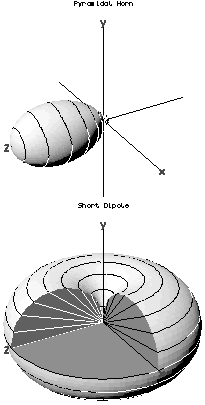
It has a doughnut-shaped pattern when viewed in 3D and a figure-of-eight pattern when viewed in 2D. DBd means gain of an antenna relative to a reference antenna with dipole radiation pattern. Antenna Gain is sometimes discussed as a function of angle.
Part Model Number Frequency VSWR Gain Design 1Y43300 MPDP125-145-4 1250-1450MHz. A lower feed point impedance than the horizontal dipole for feed points at the same height above ground. Omni directional AM antenna 4 2 t P W G pR where W is the power density in Wm2 P is the transmitted power in W R is the distance from the antenna in m and Gt is the gain of the short dipole.
Hustler 6BTV 6-Band HF Vertical Antenna and DXE Installation Guide Packages are trapped-vertical antennas that provide an omni-directional pattern. An antenna with a higher gain is more effective in its radiation pattern. Figure 1 illustrates the doughnut shaped pattern in 3D and Figure 2 illustrates the.
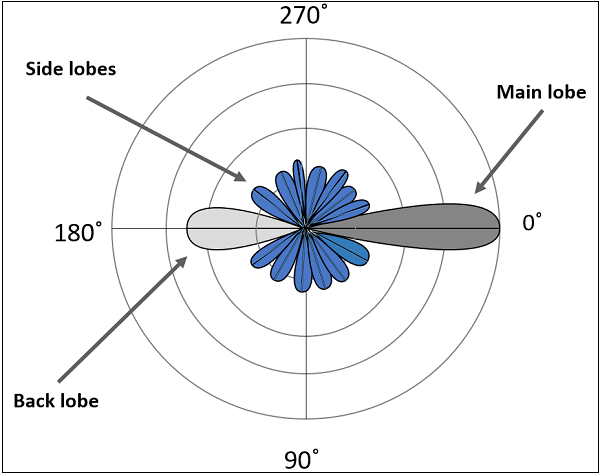
In any illustration the sketch drawn to represent the radiation of an antenna is its radiation patternOne can simply understand the function and directivity of an antenna by having a look at its radiation pattern. The results are given in the following table. Consequentially deployment of this loop orientation is uncommon.
Typical mobile antennas. Here is the radiation pattern for an 8dB gain patch antenna. Some loss in bandwidth.
Scroll to the last page. Antenna pattern testing at University of California at Riverside. Radiation Pattern of an Omni Antenna.
A more omni-directional radiation pattern than that of a dipole. Omnidirectional radiation patterns are produced by the simplest practical antennas monopole and dipole antennas consisting of one or two straight rod conductors on a common axisAntenna gain G is defined as antenna efficiency e multiplied by antenna directivity D which is expressed mathematically as. Directional antennas provide increased performance over dipole antennasor omnidirectional antennas in generalwhen greater concentration of radiation in a certain.
Antennas are designed in such a way that power raises in the wanted direction and decreases in unwanted directions. Its pattern looks similar to a donut. Read the Omni FAQ page.
Various parts of a radiation pattern are referred to as lobes which may be major minor side or back lobe. Every antenna you purchase should have a diagram showing you the radiation pattern from a vertical and horizontal perspective. The donut-shaped elevation pattern shows that a dipole antenna is best used to transmit and receive from the broadside of the antenna and is very sensitive to matching horizontal positioning and any movement away from a perfectly vertical position.
A 50 dBW eirp downlink satellite beam means that it looks like a 100000 watt transmitter connected to an omni-directional satellite antenna. There are two other indications of poor radiation efficiency that can be checked on a test bench. It is comprised of quarter-wave coaxial.
To get more gain an antenna must radiate in fewer directions. These are used when coverage is required in all directions horizontally from the antenna with varying degrees of vertical coverage. However omni-directional antennas in real life usually has signal loss on the top and bottom and the radiation pattern would look more like a doughnut in 3D.
Omnidirectional antennas do have dead spots but theyre basically not worth paying attention to for Helium deployments. Commonly known as an omnidirectional antennas all dipole antennas have a generalized radiation pattern. Omni antennas typically radiate with a gain of 21 dB over an isotropic antenna.
These antennas provide a 360 degree horizontal radiation pattern. The isotropic radiation is nothing but Omni-directional radiation. Read the QST review of the model OA-50.
Pay particular attention to their testing of the PAR Omniangle beginning on page 20 PDF. Good radiation efficiency is the ultimate goal for most antennas not just good return loss. The figures given above show the radiation pattern of an isotropic or Omni-directional pattern.
Radiation is the term used to represent the emission or reception of wave front at the antenna specifying its strength. 6BTVs were designed as self-supporting verticals to provide efficient operation in the 10 15 20 30 40 and 75 or 80 meter bands. Some say that the inverted V should be cut 5 shorter than the dipole.
Omnidirectional antennas have a similar radiation pattern. Antenna pattern is omni-directional with nulls straight up and straight down. In a two-dimensional view it forms a figure-of-eight pattern in the vertical plane and a circle in horizontal plane.
The most accurate way is to have the antenna evaluated by an antenna testing service and verify its radiation efficiency. The reference antenna might be an actual dipole antenna. However horizontally oriented loops couple strongly to ground and should be elevated a significant fraction of a wavelength above groundto prevent the incursion of significant ground losses.
These antennas perform well in restricted space areas. Measuring Antenna Radiation Patterns Antenna is rotated in an Anechoic Chamber to measure radiation pattern Radiation pattern of any antenna Is the shape of the Electro-magnetic field radiated or Received by the antenna Dipole Antenna One of the most widely used antenna types is the half-wave dipole. The half-wave dipole also called a doublet is.
An example of the radiation pattern plotted in terms of gain is shown in Figure 1.

Omnidirectional Antenna Wikipedia

Omnidirectional Antenna An Overview Sciencedirect Topics

Isotropic Antenna An Overview Sciencedirect Topics

Directional Or Omni Directional Antennas Netxl Blog

Omnidirectional Antenna Wikipedia
Frontiers A Dual Band Dual Polarized Omnidirectional Antenna Physics
2
Difference Between Omnidirectional Antenna And Directional Antenna Foshan Anderson Communication Equipment Co Ltd


